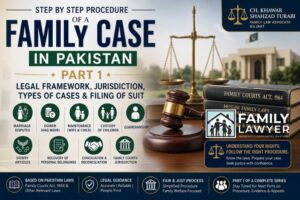
After a family suit has been properly instituted by presenting a plaint before the competent Family Court, the litigation formally begins. However, filing the plaint alone does not start the trial. Pakistani family law requires that the defendant be informed of the proceedings, given a fair opportunity to respond, and, wherever possible, the parties be encouraged to resolve the dispute amicably before the court proceeds to a full trial.
One of the distinguishing features of Family Courts in Pakistan is that they prioritize speedy justice and reconciliation over lengthy and highly technical civil procedures. This reflects the legislature’s intention to preserve family relationships whenever possible while ensuring that justice is delivered efficiently.
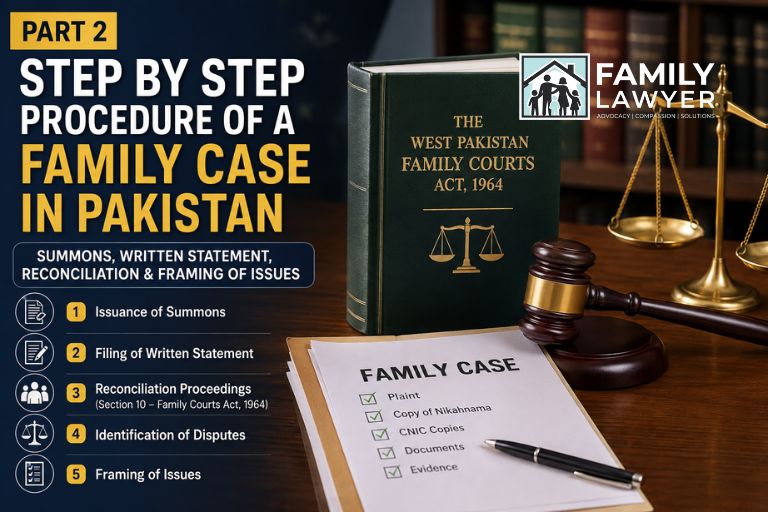
This part explains every procedural step from the issuance of summons to the framing of issues, together with the relevant statutory provisions under the West Pakistan Family Courts Act, 1964.
Step 4 – Scrutiny of the Plaint by the Family Court
Once the plaint is filed, the Family Court examines it before issuing summons.
The Court generally reviews whether:
- It has territorial jurisdiction.
- It has subject-matter jurisdiction.
- The plaint discloses a valid cause of action.
- The relief sought falls within the Schedule of the Family Courts Act.
- Necessary court fee has been affixed.
- Relevant documents have been attached.
- The names and addresses of the parties are complete.
If any defect exists, the Court may direct the plaintiff to remove the defect before proceeding further.
This preliminary scrutiny prevents unnecessary litigation and procedural delays.
Why Proper Scrutiny Is Important
Early scrutiny helps the Court:
- Eliminate technical defects.
- Ensure procedural fairness.
- Prevent abuse of process.
- Reduce avoidable adjournments.
- Facilitate quicker disposal of family disputes.
This is one reason Family Courts generally dispose of cases faster than ordinary civil courts.
Step 5 – Issuance of Summons
Once satisfied that the plaint is maintainable, the Family Court issues summons to the defendant.
The purpose of summons is simple:
- Inform the defendant that a legal case has been filed.
- Provide complete particulars of the claim.
- Allow sufficient opportunity to defend the case.
The principles of natural justice require that no person should be condemned unheard.
Section 8 – Intimation of Dates and Written Statement
One of the most important procedural provisions is Section 8 of the West Pakistan Family Courts Act, 1964, which governs the appearance of the defendant and filing of the written statement.
The section provides:
“On the institution of a suit, the Family Court shall fix a date, ordinarily not later than fifteen days, for the appearance of the defendant and shall issue summons to the defendant, together with a copy of the plaint, directing him to submit a written statement on that date.”
This provision serves several important purposes:
- Ensures early commencement of proceedings.
- Reduces unnecessary delays.
- Gives the defendant adequate notice.
- Enables the Court to proceed promptly.
Unlike ordinary civil litigation, Family Courts are expected to move quickly.
Contents of the Summons
The summons generally contains:
- Case title.
- Case number.
- Name of the Court.
- Date of hearing.
- Direction to appear.
- Direction to file written statement.
- Consequences of non-appearance.
A complete copy of the plaint accompanies the summons so that the defendant understands every allegation made by the plaintiff.
Modes of Service of Summons
The Family Court may order service through one or more legally recognized methods, depending upon the circumstances.
Common methods include:
Personal Service
Summons may be delivered personally through the process server.
Registered Post
Service through registered postal articles remains one of the most common methods.
Courier Service
Where permitted under applicable procedural rules, recognized courier services may also be used.
Electronic Means
Modern judicial practice increasingly accommodates electronic communication in appropriate circumstances, particularly where directed by superior courts or provincial rules.
Substituted Service
Where the defendant intentionally avoids service, the Court may permit substituted service in accordance with applicable law.
Examples include:
- Affixation at residence.
- Newspaper publication.
- Other modes directed by the Court.
Substituted service ensures that defendants cannot indefinitely delay proceedings by avoiding summons.
What Happens if the Defendant Avoids Summons?
Avoiding service does not indefinitely stop the case.
If the Court is satisfied that:
- summons were properly issued,
- reasonable efforts were made,
- and the defendant deliberately avoided service,
the Court may proceed according to law.
The objective is to prevent abuse of judicial process while preserving the defendant’s right to be heard.
Importance of Proper Service
Improper service may result in:
- Delay in proceedings.
- Fresh issuance of summons.
- Setting aside of ex parte proceedings in appropriate cases.
- Additional litigation costs.
Therefore, courts carefully ensure compliance with procedural requirements before proceeding further.
Step 6 – Filing of the Written Statement
After receiving summons, the defendant must appear before the Court and submit a written statement.
The written statement is the defendant’s formal response to every allegation contained in the plaint.
It should clearly state:
- Which allegations are admitted.
- Which allegations are denied.
- Facts supporting the defence.
- Relevant legal objections.
- Supporting documents.
- Counter-version of events.
The written statement forms one of the most important pleadings in family litigation.
Purpose of the Written Statement
The written statement enables the Court to:
- Identify disputed facts.
- Determine legal questions.
- Understand both parties’ positions.
- Narrow the scope of litigation.
- Prepare for reconciliation proceedings.
A vague or incomplete written statement may adversely affect the defendant’s case.
Documents Filed with the Written Statement
Depending upon the nature of the dispute, the defendant may attach:
Financial Records
- Salary certificate.
- Income tax documents.
- Bank statements.
- Business records.
Marriage Documents
- Nikahnama.
- Marriage registration certificate.
Child-Related Documents
- School records.
- Medical reports.
- Birth certificates.
- Educational expenses.
Property Documents
Where relevant:
- Ownership documents.
- Dowry lists.
- Jewellery receipts.
- Gift receipts.
Proper documentation significantly strengthens the defence.
Counter-Claim in Family Proceedings
In appropriate cases, the defendant may raise claims available under law.
For example:
- Recovery of dowry articles.
- Recovery of dower.
- Custody-related relief.
- Maintenance-related relief.
Where legally maintainable, such claims may be adjudicated together to avoid multiplicity of litigation.
Step 7 – First Appearance Before the Family Court
Once both parties appear before the Court, the proceedings become substantially different from ordinary civil litigation.
Unlike traditional civil courts, Family Courts do not immediately proceed to recording evidence.
Instead, the Court first attempts to resolve the dispute amicably.
This reflects the philosophy of family justice in Pakistan.
Section 10 – Mandatory Efforts for Reconciliation
Perhaps the most distinctive provision of the Family Courts Act is Section 10, which requires the Court to attempt reconciliation.
The statute provides:
“On the date fixed for the appearance of the defendant, the Family Court shall examine the plaint, the written statement (if any) and shall ascertain the points at issue between the parties and attempt to effect a compromise or reconciliation between the parties, if this be possible.”
This provision demonstrates that reconciliation is not merely optional—it is a statutory duty of the Family Court.
Why Reconciliation Is So Important
Family litigation differs from commercial disputes because:
- Marital relationships may still be preserved.
- Children’s welfare is directly affected.
- Emotional considerations are significant.
- Future family relationships often continue.
The law therefore encourages settlement before adversarial litigation begins.
Cases Where Reconciliation May Succeed
Reconciliation often proves effective in disputes involving:
- Maintenance.
- Visitation rights.
- Minor misunderstandings.
- Temporary separation.
- Financial arrangements.
- Parenting schedules.
Courts frequently assist parties in negotiating practical solutions.
Cases Where Reconciliation Is Less Likely
Settlement may be difficult where allegations involve:
- Domestic violence.
- Persistent cruelty.
- Forced marriage.
- Serious abuse.
- Long-term separation.
- Irretrievable breakdown of marriage.
In such situations, the Court proceeds with the legal process while ensuring fairness to both parties.
Confidential Nature of Settlement Discussions
During reconciliation proceedings, Family Courts generally encourage open discussion between the parties.
This enables:
- Honest communication.
- Flexible settlements.
- Child-focused solutions.
- Reduction of hostility.
Many disputes conclude successfully at this stage without requiring a full trial.
Benefits of Early Settlement
Successful reconciliation offers numerous advantages:
- Saves time.
- Reduces litigation expenses.
- Protects children’s emotional wellbeing.
- Preserves family relationships where possible.
- Minimizes public conflict.
- Provides quicker enforcement of agreed terms.
For many families, settlement represents the most practical outcome.
If Reconciliation Fails
Where reconciliation is unsuccessful, the Family Court records that no settlement could be reached.
The litigation then moves toward formal adjudication.
The Court proceeds to identify the actual disputes requiring determination.
Step 8 – Identification of the Questions in Dispute
After reviewing:
- the plaint,
- written statement,
- documents,
- and submissions of both parties,
the Court identifies the real controversy between the parties.
Typical disputed questions include:
- Whether maintenance is payable.
- Whether cruelty has been established.
- Whether dower remains unpaid.
- Whether dowry articles were retained.
- Who should receive custody.
- Whether visitation should be granted.
- Whether the welfare of the child requires a different arrangement.
Identifying these issues narrows the scope of evidence and promotes efficient adjudication.
Framing of Issues
Although Family Courts are not bound by every procedural technicality applicable to ordinary civil suits, identifying the questions requiring determination remains essential.
Well-defined issues:
- focus the evidence,
- reduce unnecessary testimony,
- shorten proceedings,
- and enable reasoned judgments.
For example, in a maintenance suit, the Court may determine:
- Whether the plaintiff is legally entitled to maintenance.
- Whether the defendant has sufficient financial capacity.
- What amount would be fair and reasonable.
Similarly, in a custody matter, the paramount consideration is the welfare of the minor, not merely the legal rights of either parent.
Practical Tips for Litigants at This Stage
Attend Every Hearing
Failure to appear may result in adverse procedural consequences, including ex parte proceedings where permitted by law.
Bring Original Documents
Original records help the Court verify authenticity and avoid unnecessary objections.
Cooperate During Reconciliation
Even if complete settlement is not possible, partial agreements regarding maintenance, visitation, or interim arrangements can significantly reduce the length and cost of litigation.
Maintain Respectful Conduct
Family Courts expect parties to behave respectfully toward the Court and each other. Professional and courteous conduct often contributes to smoother proceedings.
Facts and Figures About Family Litigation in Pakistan
- Family Courts across Pakistan collectively hear tens of thousands of new family disputes each year, with the largest share relating to maintenance, child custody, dissolution of marriage, and recovery of dower.
- Judicial reforms and case management initiatives have increasingly focused on reducing delays, encouraging mediation, and improving access to justice for women and children.
- Research and judicial observations consistently show that early reconciliation and negotiated settlements resolve a significant proportion of family disputes without the need for prolonged trials, reducing both emotional and financial costs.
Key Takeaways
The period between filing the plaint and commencement of evidence is one of the most important stages in a family case. During this phase, the Family Court ensures that the defendant receives proper notice, obtains a written response, and fulfills its statutory duty to attempt reconciliation under Section 10 of the West Pakistan Family Courts Act, 1964. Only after these preliminary steps have been completed does the Court move toward formal adjudication by identifying the issues requiring determination.
A properly drafted written statement, timely appearance before the Court, and genuine participation in reconciliation proceedings can significantly influence both the duration and outcome of the case.
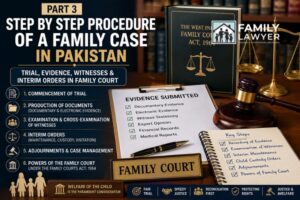
In Part 3, we will examine the next phase of the proceedings, including recording of evidence, examination and cross-examination of witnesses, admissibility of documentary and electronic evidence, interim orders, maintenance during the pendency of the suit, and the powers of the Family Court during trial.